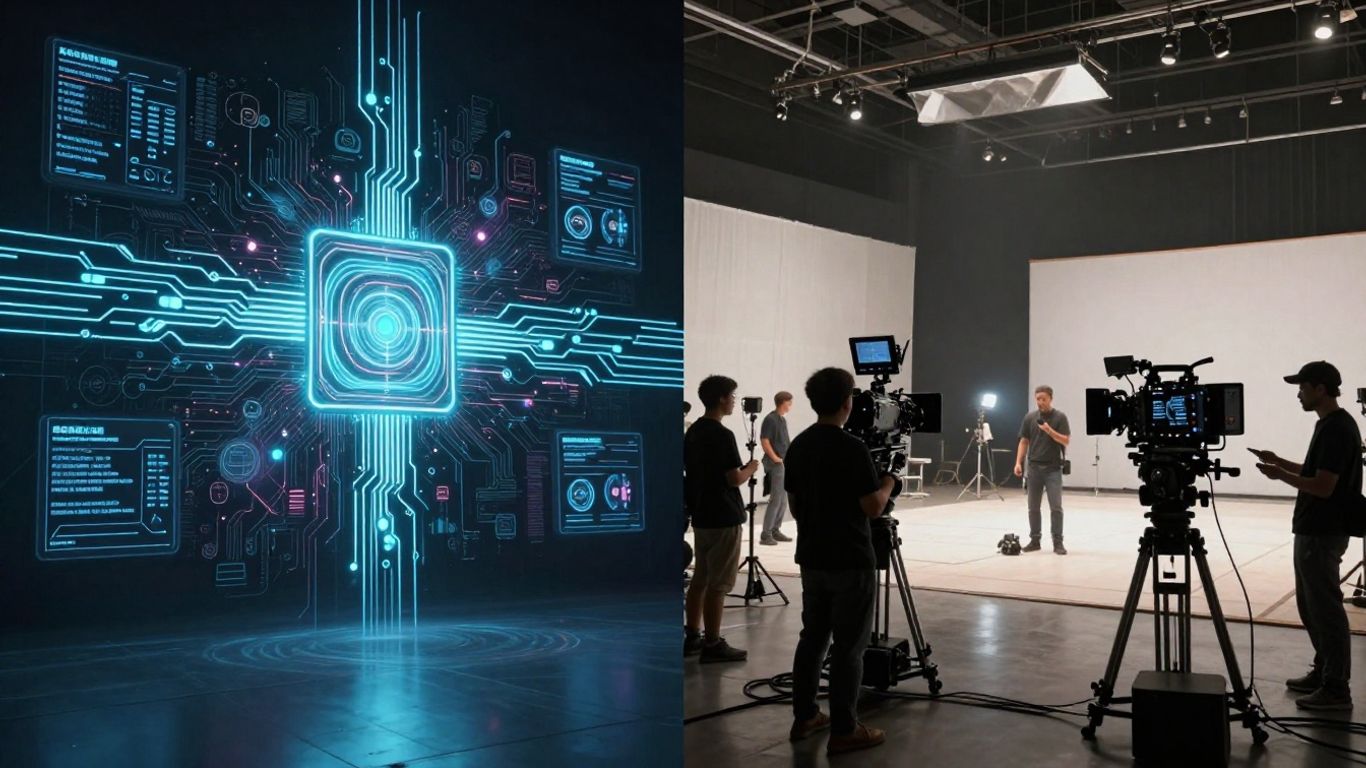
Thinking about making a music video? You’ve probably heard about AI tools that can whip them up in a flash, but how do they stack up against the old-school way? We’re going to break down the whole ai music video production vs traditional scene, looking at what it costs, how fast you can get stuff done, and what kind of quality you can expect. It’s not always a clear-cut winner, and understanding the differences will help you pick the right path for your project.
Key Takeaways
- AI music video production is way cheaper, often costing just a few dollars per minute compared to thousands for traditional methods. This makes it super accessible for artists and creators on a budget.
- Speed is a huge win for AI. You can go from an idea to a finished music video in hours or days, while traditional production can take weeks or even months.
- While AI quality is getting really good, traditional production still offers more control over subtle artistic nuances and emotional depth, especially for high-end projects.
- AI tools like Creatus offer a combined workflow, letting you create a song with AI vocals and then turn it directly into a music video without switching between different software.
- AI makes it easy to create many different versions of your video for various platforms like TikTok, Instagram, and YouTube, which is much harder and more expensive with traditional methods.
Understanding The Cost Differences: AI Music Video Production vs Traditional
When you look at making a music video, the price tag is usually one of the first things that comes to mind. Traditional methods involve a lot of moving parts, and each one adds to the bill. Think about hiring a crew, renting gear, finding locations, and then spending weeks in editing. It all adds up fast.
AI Production’s Budget-Friendly Approach
AI music video production flips this script. Instead of paying for people and physical resources, you’re often paying for access to a platform or a subscription. This means costs are much more predictable. You can get a lot done without needing a big upfront investment.
Traditional Production’s Significant Investment
Making a music video the old-fashioned way is a serious financial commitment. You’re looking at costs for directors, camera operators, lighting technicians, editors, and more. Add in studio time, travel, and potential reshoots, and the budget can easily balloon. For a professional-looking video, you might be spending thousands, if not tens of thousands, of dollars.
Comparing Cost Per Minute and Volume
Let’s break down the numbers. Traditional video production can cost anywhere from $1,000 to $10,000 per finished minute. This is for basic to standard quality; high-end projects go much higher. AI, on the other hand, can bring that cost down to as little as $0.50 to $2.13 per minute. This is a massive difference, especially if you need multiple videos or variations. For example, producing 20 different ad versions with AI costs only a little more than one. Doing that traditionally would be prohibitively expensive.
| Production Type | Estimated Cost Per Minute |
|---|---|
| Traditional Production | $1,000 – $10,000+ |
| AI Production | $0.50 – $2.13 |
The predictability of AI pricing is a huge advantage. You know what you’re going to spend, unlike traditional methods where unexpected issues can always pop up and increase the final bill.
Evaluating Production Speed: AI Music Video Production vs Traditional
When you’re trying to get your music out there, how fast you can make a video matters. Traditional methods take a long time. You’re looking at weeks, sometimes months, from the initial idea to the final cut. This involves planning, shooting, and a lot of editing.
AI, on the other hand, changes the game entirely. You can generate a music video in a fraction of the time. Think hours or a couple of days, not weeks. This speed means you can react much faster to trends or release new content more frequently.
AI’s Rapid Turnaround Times
AI tools can create a music video from start to finish surprisingly quickly. You input your song, maybe some prompts, and the AI does the heavy lifting. This process can often be completed within 24 to 48 hours. It’s a huge difference compared to the traditional route.
The Extended Timeline of Traditional Methods
Traditional music video production is a multi-step process. You need a director, a crew, locations, and then the editing phase. Each of these stages takes time. A single shoot day can involve hours of setup and filming, followed by weeks of post-production work. This makes it hard to be quick.
Impact of Speed on Market Responsiveness
Being able to produce videos fast gives you a real advantage. You can jump on a trending topic or release a video to coincide with a specific event. With traditional methods, by the time your video is ready, the moment might have passed. AI allows you to stay relevant and keep your audience engaged with fresh content more consistently.
Assessing Quality and Creative Control
AI’s Evolving Visual Capabilities
AI video generation is getting better fast. You can get some pretty decent visuals now, often with a polished, professional look. These tools can create a consistent style across your video, which is great for branding. The main advantage here is predictability; what you see is often what you get, with fewer surprises.
Traditional Production’s Artistic Nuance
With traditional methods, you have total control. You can direct actors, fine-tune camera angles, and adjust lighting precisely. This allows for a level of emotional depth and storytelling that AI is still working towards. You can capture specific locations and real human interactions that add a unique feel.
Balancing Creative Vision with AI Tools
Think about what you really need. If you’re aiming for a specific, nuanced artistic vision or deep emotional connection, traditional production might still be your best bet. However, AI tools are becoming powerful partners. You can use them for rapid prototyping of ideas or to generate specific visual elements that would be time-consuming otherwise. It’s about finding the right mix for your project’s goals.
Scalability and Flexibility in Production
When you need to produce a lot of video content, AI really shines. It lets you create many different versions of a video without starting from scratch each time. This means you can easily adapt your content for different audiences or platforms.
Traditional production makes scaling up expensive. Every new version or regional adaptation usually means a whole new shoot. This quickly drives up costs and extends timelines. AI, on the other hand, handles variations efficiently. You can tweak visuals, messages, or styles with much less effort and cost.
AI’s Advantage in Content Variation
AI tools allow you to generate numerous video variations from a single production cycle. Need to test different taglines or visual styles? AI can do that quickly. This adaptability is perfect for A/B testing creative ideas or targeting multiple market segments with precision. You can get a lot more mileage out of your initial creative effort.
Limitations of Traditional Scaling
Scaling traditional video production often means starting over for each new requirement. If you need a video for TikTok, then another for YouTube, and maybe a third for Instagram, traditional methods demand separate shoots and extensive editing for each. This is time-consuming and costly. You might find yourself spending thousands on reshoots or additional editing just to get a few different versions.
Adapting Content for Multiple Platforms
AI makes adapting your content for different platforms straightforward. You can export your music video in various aspect ratios, like 16:9 for YouTube, 9:16 for TikTok and Reels, or 1:1 for Instagram feeds. This ensures your video looks good everywhere you share it, without needing complex reformatting or additional production work. It’s about getting your content seen in the best way possible on every screen.
AI streamlines the entire workflow, taking a project from concept to completion much faster than traditional methods. By cutting out common bottlenecks, AI systems ensure quick turnarounds, making it easier to meet tight deadlines and adapt to shifting market demands. This efficiency marks a significant leap from older production models to a more agile approach.
The Integrated Workflow of AI Music Video Production
Combining Song and Video Creation
AI tools let you create both the music and the video in one place. You can start with just a text idea, and the AI can generate a complete song, including vocals. This means you don’t need separate software for music production and video editing.
Eliminating the Need for Tool Switching
Imagine going from a song idea to a finished music video without ever leaving the same platform. This is what AI integration offers. You type your concept, the AI writes the song, and then it generates the video to match. This single-step process saves you a lot of time and hassle.
Streamlining the Entire Production Process
This integrated approach simplifies everything. You can generate a song with AI vocals, then feed that audio directly into the video generator. The AI analyzes the music’s structure and mood to create synchronized visuals. It’s a much smoother path from concept to final product compared to traditional methods.
Key Differentiators in AI Music Video Production vs Traditional
AI Singing Vocals Versus Human Performance
AI music video tools can now generate full songs with singing vocals, not just instrumentals. This means you can go from a text idea to a complete song with a voice, all within one platform. It’s a big step from earlier AI music tools that only produced background tracks.
Traditional production relies on human singers, which brings a certain emotional depth and unique performance style. AI vocals are getting closer, but they might still lack the subtle imperfections and raw emotion a human artist delivers. The choice often comes down to whether you prioritize unique human expression or the convenience and speed of AI.
Multi-Format Export for Diverse Platforms
AI production platforms often let you export your music video in multiple formats right away. You can get vertical 9:16 for TikTok and Reels, square 1:1 for Instagram feeds, and standard 16:9 for YouTube, all from the same project. This makes it easy to get your content ready for different social media channels without extra editing.
Traditional methods usually require you to shoot with a specific format in mind or spend extra time and money reformatting footage in post-production. This can be a hassle when you need to adapt your video for various platforms quickly.
Accessibility for Non-Technical Users
AI music video creation is designed to be accessible. You can often start with just a text prompt and get a song and video without needing to learn complex software. This opens up music video production to independent artists, small businesses, or anyone who doesn’t have a background in video editing or music production.
Traditional music video production demands a team of specialists and a significant learning curve for anyone trying to do it themselves. The technical skills required for directing, shooting, and editing can be a major barrier. AI tools aim to remove these barriers, making visual content creation more democratic. For those looking to create their first music video, exploring tools like Soundverse DNA can be a good starting point.
Making music videos with AI is super different from the old way. AI can whip up visuals from just words, making things faster and cheaper. Traditional methods need lots of people and gear. Want to see how easy it is to create your own AI music video? Visit our website today and try it out!
Wrapping Up: AI vs. Traditional Music Videos
So, where does that leave you? If you’re an indie artist on a tight budget or a creator needing quick content, AI tools like Creatus offer a way to get a song and a video out there without breaking the bank or waiting months. You get speed and affordability, no doubt. But if you’re aiming for that big-budget, cinematic feel with precise artistic control and emotional depth, traditional production still holds its ground. It’s not about one being ‘better’ overall, but about picking the right tool for your specific project and goals. For many, a mix of both might be the smartest way forward.
Frequently Asked Questions
How much does it cost to make a music video with AI compared to the old way?
Making a music video with AI is way cheaper! Think of it like this: traditional videos can cost thousands, even tens of thousands of dollars per minute. AI video production, on the other hand, might only cost a few dollars per minute. So, if you’re on a tight budget, AI is a super smart choice.
Can AI really make a whole song and video, or is it just basic stuff?
It’s pretty amazing! Tools like Creatus AI can actually create a full song with AI singing vocals just from your text ideas. Then, it turns that song into a music video. You don’t need to be a musician or a video expert. It’s like having a whole production team in one easy-to-use tool.
How fast can you get a music video from AI?
Super fast! While traditional music videos can take weeks or even months to make because of all the planning, shooting, and editing, AI can whip up a video in just hours or a couple of days. This means you can get your music out there much quicker.
What if I want my video to look a certain way? Can AI handle that?
AI video quality is getting really good, and it’s improving all the time. While traditional methods might still have an edge for super high-end, artistic films, AI is totally capable of making professional-looking videos for most purposes, like social media or online promotion. Plus, you can often pick different styles to match your vibe.
Do I need to be good at tech stuff to use AI for music videos?
Nope, not at all! Most AI music video tools are designed to be user-friendly. You don’t need to know anything about video editing or music production. You just provide your idea, and the AI does the heavy lifting. It’s made for creators, not just tech wizards.
Can I use AI-made music videos on different social media platforms?
Absolutely! A big plus with AI tools is that they often let you export your video in different sizes. So, you can easily get versions perfect for TikTok, Instagram Reels, YouTube Shorts (that’s the tall, 9:16 format), or even standard YouTube videos (the wide, 16:9 format). It makes sharing your work everywhere a breeze.